


Visualizing Automotive Panel Dynamics Using Operational Deflection Shapes (ODS)
Operational Deflection Shapes (ODS) derived from scanning particle velocity measurements provide a powerful and intuitive way to visualize structural vibration behavior under real operating conditions. In this case study, a vehicle door is analyzed using a scanning P-U probe combined with phase reference measurements, enabling high-resolution animated ODS results that reveal critical vibration patterns across different excitation conditions.
STAY UPDATED WITH THE LATEST SOUND AND VIBRATION RESEARCH
Subscribe to our Newsletter
Understanding Structural Dynamics Through ODS Visualization
Understanding how structures vibrate under operational conditions is essential for controlling noise, vibration, and harshness (NVH). Operational Deflection Shapes (ODS) provide a direct visualization of this behavior, representing how a structure deforms at specific frequencies for a particular operational configuration.
Unlike classical modal analysis, ODS focuses on real operating conditions, making it particularly suitable for identifying dominant vibration patterns and problem areas. An ODS can be interpreted as a “snapshot” of structural motion at a given frequency for certain condition, offering immediate physical insight into system behavior.
Particle Velocity Mapping
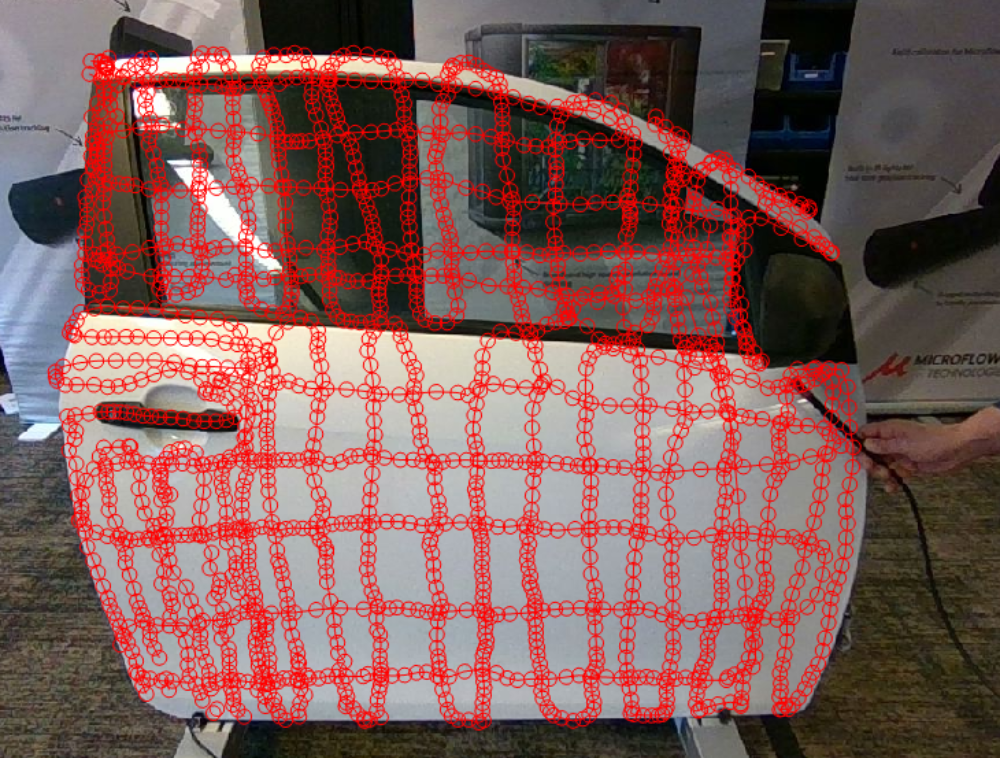
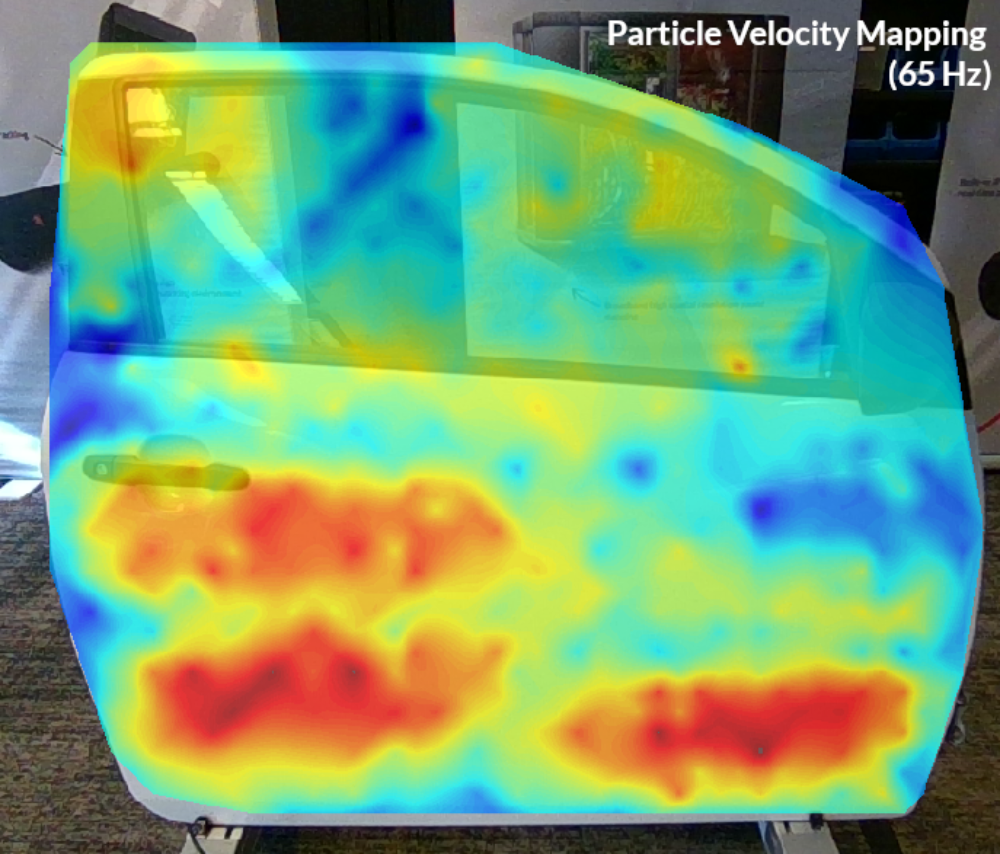
Under near-field conditions, particle velocity is directly proportional to the structural vibration velocity, enabling non-contact vibration measurements. In this case, a vibration driver was mounted on the inner side of a car door, while the outer surface was measured using Scan & Paint 2D. Direct mapping of acoustic particle velocity (static results), such as those shown here, is very effective in highlighting regions of high excitation and displacement. However, these static results do not fully reveal the underlying vibration mechanisms responsible for the radiated sound, which can be key for understanding the root cause of an issue and implementing effective mitigation measures.

Car Door Window Deflection Shapes
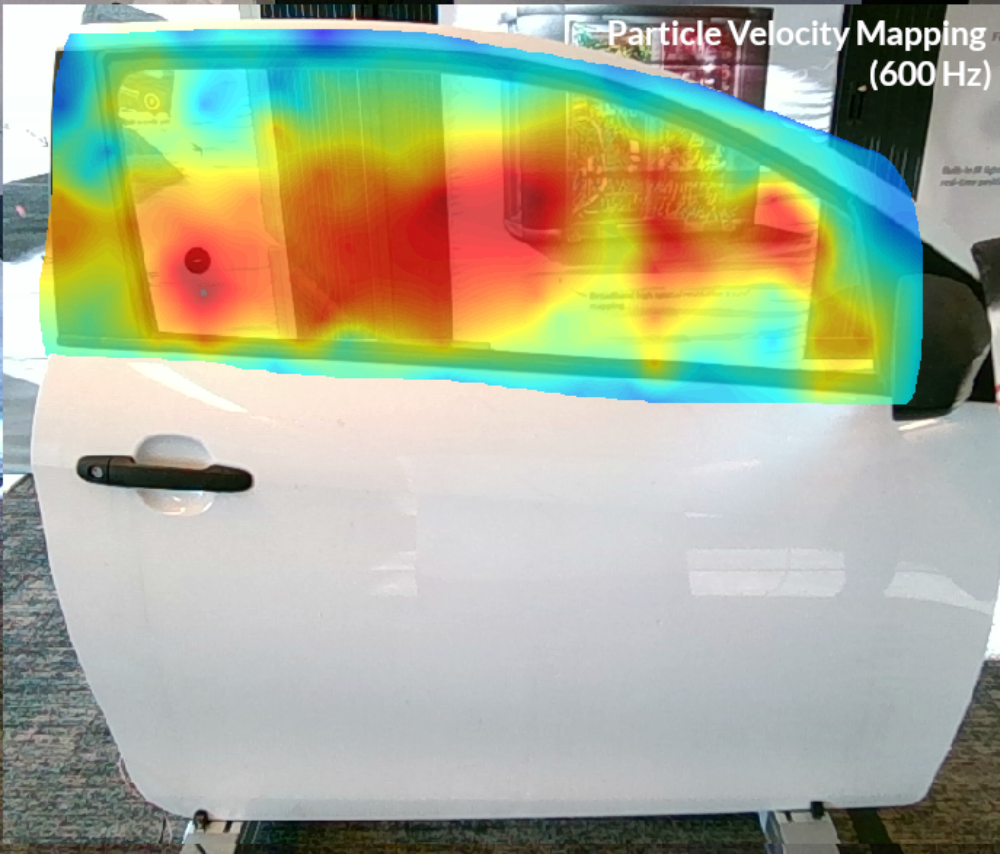
Acoustic particle velocity data can be combined with a relative phase reference to characterize complex vibro-acoustic behaviour. By processing the probe signal together with cross-spectral phase information, the relative motion between different areas can be reconstructed. When visualized as an Operational Deflection Shape (ODS), the dynamic response of the structure becomes clear, in this case, revealing how different regions of the window move relative to each other, including in-phase and out-of-phase behavior, as well as the formation of nodal patterns.
Car Door Panel Deflection Shapes
Understanding low-frequency operational modal behavior can be challening in application settings. Limitations in space, surface reflections or even time constrains can prevent for ODS analysis in many practical cases. In contrast, in this example we can see that in a matter of minutes, the first mode of the car door at 65 Hz can be clearly identified. This information is key designing effective noise control measures, selecting the right areas to add stiffness or damping depending on the frequency range and nature of the problem aimed to solve.
Boosting Efficiency and Measurement Coverage
Scanning techniques enable rapid acquisition of high-resolution vibro-acoustic data, reducing measurement time from hours to minutes while maintaining accuracy and requiring minimal instrumentation. Unlike discrete sensor-based approaches, the continuous scanning method provides dense spatial coverage of the structure, minimizing the risk of missing critical vibration features and avoiding spatial aliasing effects. The result is a more complete representation of the structural response, with vibration patterns captured across the entire surface and directly visualized on the geometry for efficient interpretation.
Conclusions
Scanning particle velocity combined with phase-referenced measurements enables fast and accurate reconstruction of Operational Deflection Shapes. Applied to an automotive door, the method reveals both localized and global vibration mechanisms. The ability to generate high-resolution animated ODS provides a powerful diagnostic tool, transforming complex vibration data into intuitive visual insight. This makes the technique highly effective for NVH development, troubleshooting, and design optimization.
 Scan&Paint 2D