


Robotic Acoustic Scanner
-
Sound Intensity Probes
-
Particle Velocity Sensors
-
Sound Sources | VVS
-
Portable Measurement Devices
-
Sound Source Localization
-
Acoustic Material Testing
-
Sound Power & Source Ranking
-
End of Line testing software
-
Acoustic Testing & Analysis Software
-
Sensor Arrays
-
Preamplifiers & Frontends
-
Accessories
Robotic Acoustic Measurement with Universal Robots
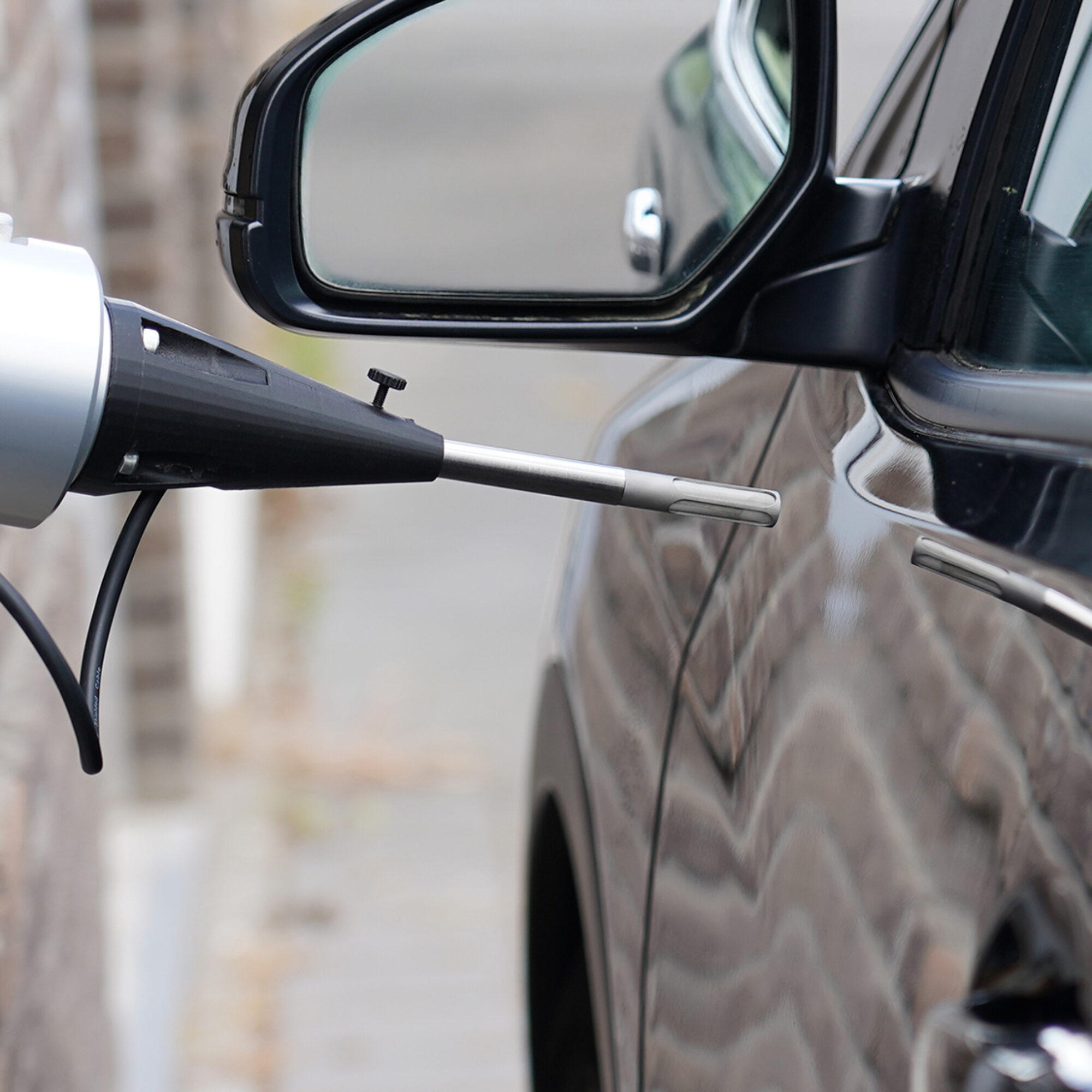
Experience the next generation of acoustic testing with Microflown’s robotic measurement solution. By integrating Universal Robots with our acoustic measurement platforms, precise sound field visualization becomes possible in environments where manual operation is difficult, restricted, or unsafe. Mounting Microflown probes on a UR robotic arm enables highly repeatable measurements of stationary and non-stationary sound fields, while extending access to areas that are hard to reach manually.



Key Benefits
- Automated and repeatable measurements
Ensure consistent results across test campaigns - Real-time 3D visualization
Directly map acoustic intensity onto your geometry - Access challenging environments
Safely measure in confined or hard-to-reach areas - High spatial resolution
Capture detailed acoustic behavior with precision
Interested in Purchase, Rental or Engineering Services?
From Setup to Measurement
A typical measurement process consists of the following steps:
- Import Geometry: Import a 3D model into VELO from CAD data or scanned geometry. This model serves as the reference for data visualization and analysis.
- Coordinate Alignment: Synchronize the robot and VELO coordinate systems by selecting a set of reference points in VELO and guiding the robot sequentially to these same physical positions. The system automatically calculates the transformation, enabling accurate spatial mapping.
- Define Robot Trajectory: Define the scanning path on the robot using standard tools such as the UR Teach Pendant (URCap) or offline environments like RoboDK. The Universal Robot must be connected to VELO via Ethernet, enabling communication through standard TCP/IP interfaces.
- Start Measurement: Initiating the scan from the robot interface automatically triggers synchronized data acquisition in VELO, allowing remote and hands-free operation. Acoustic quantities such as sound intensity vectors are visualized live and mapped onto the 3D model as the robot moves.
Enabling Acoustic Measurements in Restricted or Hazardous Areas
Some environments make manual measurements unsafe or impractical, due to moving machinery, extreme temperatures, or strict safety regulations. Robotic integration enables high-quality acoustic measurements without exposing personnel to risk. Whether inside a high-voltage test cell, near operating equipment, or within a test bench with moving parts, robotic scanning allows measurements where manual access is limited.

Robotic Integration Adds Built-in Position Tracking
Traditional scanning systems often rely on external optical tracking. With a robotic scanner, the robot’s internal kinematics provide precise position data in real time, eliminating the need for additional tracking hardware. This simplifies setup, reduces potential error sources, and ensures consistent results, especially in repetitive tests or limited-access environments.
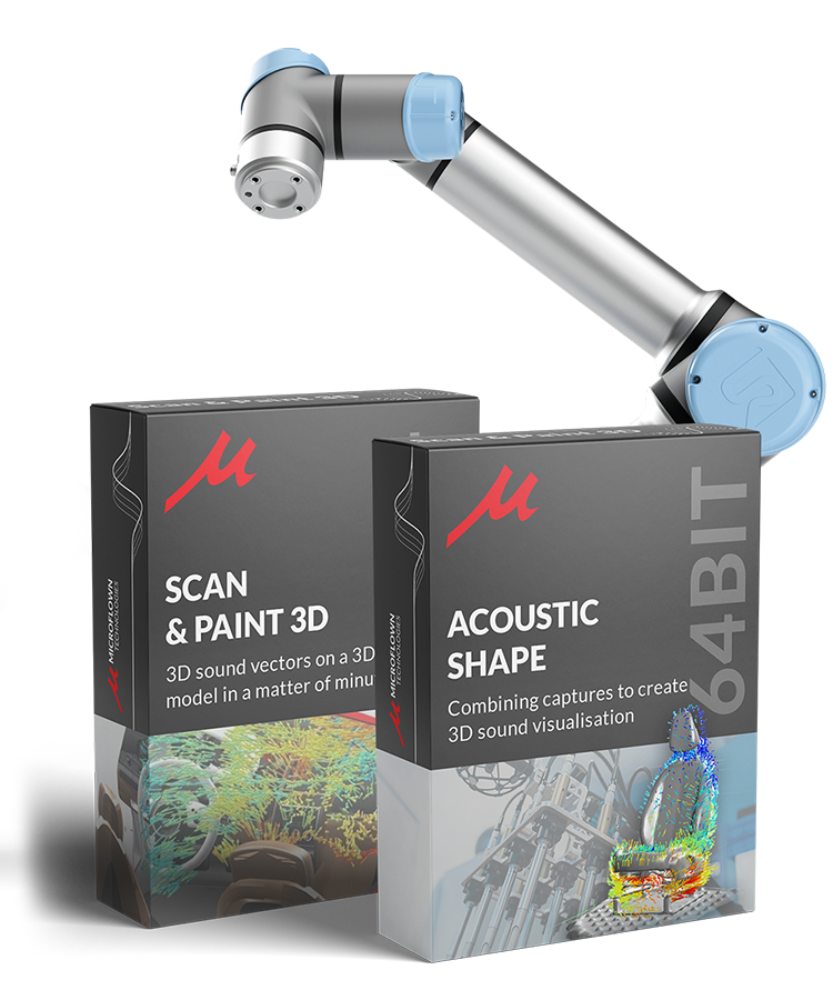
Seamless Integration with Scan&Paint 3D and Acoustic Shape
The robotic system is compatible with both Scan&Paint 3D and Acoustic Shape. In Scan&Paint 3D, the robot performs precise volumetric scans, replacing manual probe movement while maintaining the spatial resolution required for 3D sound intensity mapping. In Acoustic Shape, the robot positions the probe array at predefined locations with high repeatability, eliminating the need for operator presence inside the test environment. Both applications benefit from automated operation and remote handling.
Probe Mounting and Positioning Tools
A dedicated set of accessories ensures reliable robotic measurements. A custom probe adapter keeps the sensor’s position and orientation fixed, with a quick click-in connection. Spacer tools define key scanning locations, allowing controlled surface contact and consistent probe distance, particularly on complex or curved surfaces.

faq
-
We currently support any cobot from the UR and URe series from Universal Robots. These models offer different ranges and payloads, allowing you to choose the best fit for your test environment.
-
Yes. A Universal Robot can be integrated with your current Scan&Paint 3D or Acoustic Shape setup. Depending on your measurement use case, you can operate the systems using a traditional optical tracker or a robot scanner. We provide all necessary mounting components and integration support to enable smooth robotic control of the probe.
-
The measurement path is defined directly on the robot using the UR Teach Pendant or offline programming tools such as RoboDK.
-
A robotic scanner offers exceptional repeatability, with UR robots achieving down to 0.03 mm accuracy depending on the model. This level of precision ensures consistent probe positioning, which is critical for high-resolution acoustic data. In many cases, the repeatability surpasses what is achievable with manual scanning.
-
The reach depends on the selected Universal Robot model. For example, the UR7e offers a reach of up to 850 mm, while the UR20 extends up to 1750 mm. For detailed specifications, please refer to the Universal Robots e-Series product page.
-
Absolutely. We support fully custom path definitions, mounting configurations, and workflow adaptations. Whether you need to measure a complex 3D surface, integrate with a specific test rig, or scan through a non-standard volume, we can adapt the system to meet your needs. Our team can work closely with you to support your testing campaign.
 Scan&Paint 3D
 Scan&Paint 2D