


Detecting Acoustic Leakage in a Car Cabin Interior Using Wind Tunnel Measurements

Ensuring a quiet and comfortable driving experience is a priority for automotive manufacturers. One of the key challenges in achieving this goal is minimizing unwanted noise caused by acoustic leakage and weak insulation. This case study explores how a 3D sound intensity mapping solution was used to detect sealing defects and characterize the acoustic output of multiple constructive elements.
Acoustic Testing inside a Wind Tunnel
To simulate real-world driving conditions while testing indoors, all measurements were conducted inside a wind tunnel. This controlled environment allowed for consistent and repeatable airflow excitation, enabling the accurate identification of areas where external airflow-induced noise entered the cabin. A Scan&Paint 3D system was used to capture the full sound field by manually scanning the cabin interior while operating the wind-tunnel at a stationary speed.
Traditionally, detecting acoustic noise sources inside a vehicle cabin is particularly challenging due to the constrained space, especially when targeting low-frequency problems and/or spatially distributed sources. These conditions make it difficult to use acoustic cameras successfully, as they rely on assumptions that may not hold in such an environment. In contrast, 3D sound intensity reveals the acoustic net propagating energy direction and quantity across space without requiring further assumptions, making it suitable for obtaining spatially detailed results without artifacts.
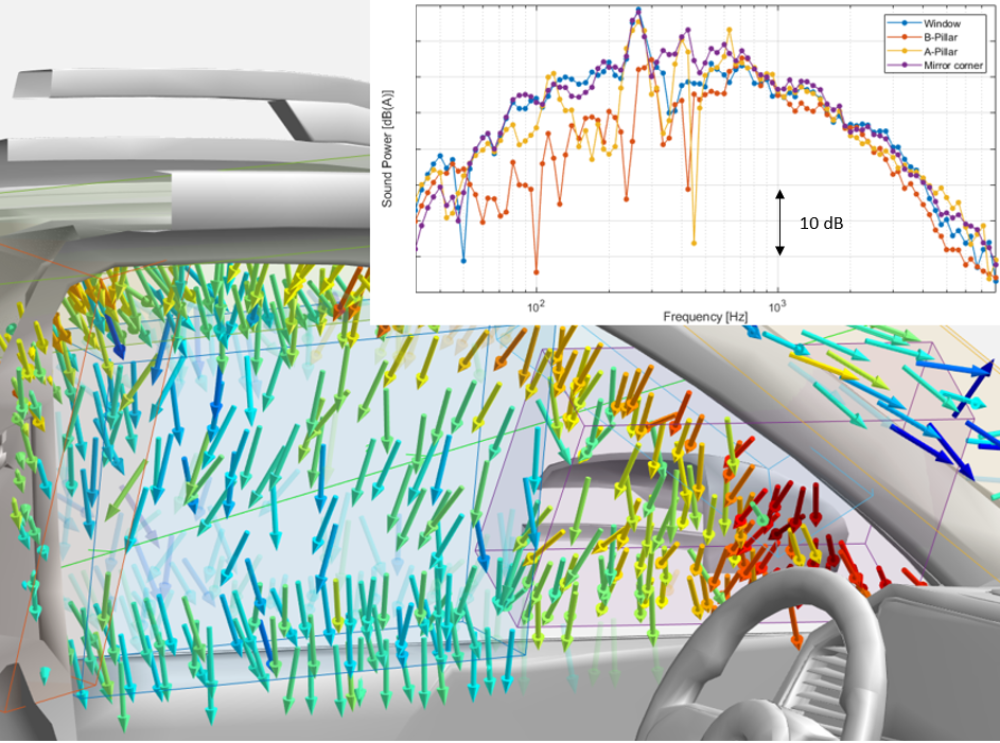
Dominant Noise Source at the A-Pillar/Window Glass Corner
One of the key dominant sources was identified at a specific frequency range near the corner between the A-pillar and window glass. This effect was particularly prominent in the region adjacent to the outdoor mirror, where high aero-acoustic loads are present. The turbulent airflow interacting with the mirror and pillar generated pressure fluctuations, which excited the vehicle's structures and induced noise transmission into the cabin. Understanding this dominant source enables engineers to better design efficient solutions.
Acoustic Leakage Through Door Sealing
By mapping the sound field across different measurement points, results provided a clear visual representation of acoustic weak spots. The results revealed broadband excitation areas introduced into the cabin through leakage in the door sealing. These areas exhibited higher levels of acoustic energy, particularly at mid frequencies, indicating that the door seals were inefficient.
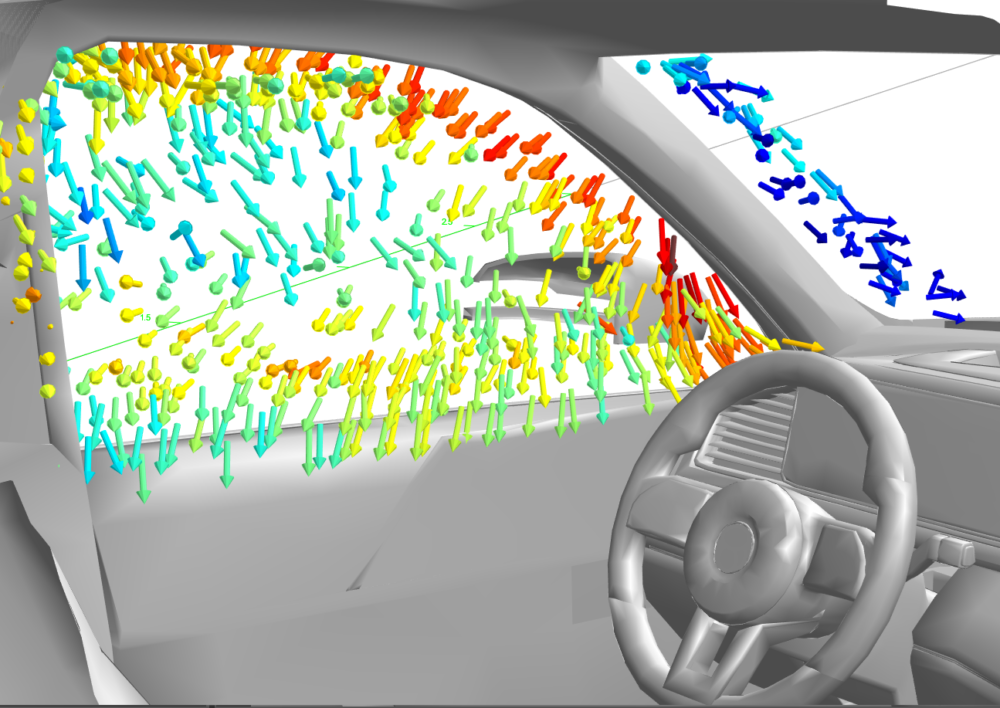
Comparison Between Baseline and Sealed Condition
To further investigate the impact of leakage-induced noise, an additional test was conducted comparing the baseline state of the car with a sealed condition. The sealed state was achieved by taping all outer gaps and replacing the water stop strip, effectively minimizing potential noise intrusion paths. The comparison revealed that the most significant reduction in noise levels occurred in the 1 kHz octave band, highlighting the necessity for enhanced door sealing to mitigate wind-induced noise inside the cabin.
Conclusions
This study demonstrates the effectiveness of Scan&Paint 3D in detecting and visualizing acoustic leakage and weak insulation areas in a vehicle’s cabin interior. The ability to capture and analyze a sound field with a high spatial resolution in real-time enables automotive engineers to make data-driven decisions when optimizing vehicle NVH (Noise, Vibration, and Harshness) performance. By performing detailed 3D acoustic measurements, manufacturers can reduce unwanted noise in order to enhance cabin comfort.
 Scan&Paint 3D
 USP regular | 3D Acoustic Vector Sensor
 Extension Bar