

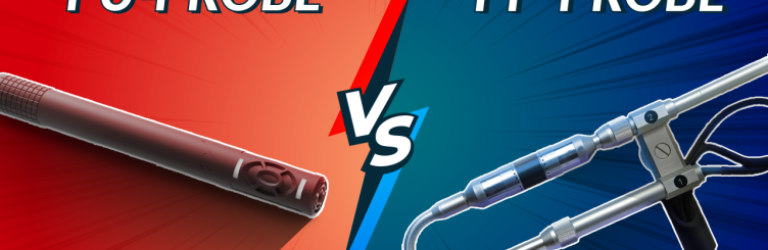
Unleashing full bandwidth Sound Power with PU probes
The Challenge with Traditional Pressure-based Measurement Techniques
Traditionally, sound power has been measured mostly using sound pressure-based techniques (ISO series 3741-3746). The main limitation of these methods is that they often require special measurement rooms, such as anechoic or reverberant chambers, which can be impractical for large or heavy equipment.
Sound Intensity-based Sound Power: PP and PU Probes
When it comes to measuring sound power, sound intensity-based methods are commonly used in situ. These methods involve calculating sound power by spatially integrating normal sound intensity over a closed volume. Sound intensity probes are typically used for these measurements, and there are two types available: PP and PU probes.
STAY UPDATED WITH THE LATEST SOUND AND VIBRATION RESEARCH
Subscribe to our Newsletter


PP probes consist of two pressure microphones that approximate sound intensity by combining the average pressure and pressure gradient. However, they can be relatively large and are highly dependent on the acoustic conditions of the measurement environment. Additionally, the pressure gradient approximation is only valid in a limited frequency range.
In contrast, PU probes directly measure sound intensity from the sound pressure and particle velocity using a microphone and a particle velocity sensor at a single point. PU probes are superior in noisy industrial environments or inside vehicle cabins, as they primarily depend on the reactivity of the sound field and are marginally affected by surrounding sound sources.
Expanding the Standards for PU Probes
Although the potential of PU probes has been recognized, current sound intensity-based ISO standards (ISO 9614-1, 9614-2, and 9614-3) only regulate the use of PP intensity probes. A study by Fernández Comesaña, Peksel, and de Bree (2014) outlined the theoretical basis of sound intensity methods using both PP and PU probes and expanded the standard measurement procedure to include PU probes. The researchers introduced a new field indicator that accounts for the measurement error of a direct sound intensity approach and compared the experimental data for both systems.

The Future of Sound Power Measurement
The introduction of PU probes marks a significant milestone in the field of sound power measurement. Recent studies have demonstrated that these innovative probes offer a more practical solution than traditional PP probes, as they require only an increase in measurement distance from the sound source to improve accuracy, instead of changes in the testing environment. This new approach could revolutionize the way we measure sound power, providing engineers and manufacturers with more precise and reliable data to inform their design and equipment selection decisions. Moreover, the relatively small size of PU probes means they can be easily extended to capture the full 3D sound intensity vector, opening the door for more advanced and comprehensive solutions to determine sound power. With the potential to enhance accuracy and efficiency in sound power measurement, PU probes represent the future of the industry. As we continue to advance our understanding of acoustics, we can expect further improvements in measurement techniques and standards that will benefit the engineering and manufacturing sectors.
Reference
Fernández Comesaña, D., Peksel, B. O., & de Bree, H.-E. (2014). Expanding the sound power measurement criteria for sound intensity p-u probes. In Proceedings of the 21st International Congress on Sound and Vibration (ICSV 21).
 Sound Intensity Probes